I was in Seoul on April 30, 2015, and I witnessed firsthand, a transformative power of urban renewal. What I saw was a remarkable example of ecological restoration: an area that had once been a bleak, concrete-covered artery—effectively a buried creek used as a thoroughfare—had been painstakingly reverted to its original, vibrant state.
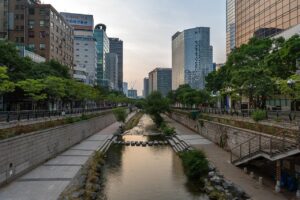
The restoration of the Cheong Gye Cheon (Cheonggyecheon) stream is a world renowned case study in urban greening and environmental engineering. The original creek, which had been paved over and obscured by an elevated highway for decades, was brought back to life as a flowing waterway. The difference between its past function as a piece of infrastructure and its current form as an ecological public space is staggering.
Today, the Cheong Gye Cheon is a beautiful, accessible urban park featuring a clean, overflowing stream that runs through the heart of the city. This project has not only enhanced the aesthetic appeal of Seoul but has also yielded significant environmental benefits, such as reducing the urban heat island effect, creating a natural habitat for various flora and fauna, and serving as a vital community space for recreation and relaxation. Seeing the water flowing and people enjoying the restored natural environment was a powerful testament to the vision and commitment behind the project.
The remarkable restoration of the Cheong Gye Cheon stream stands as a powerful symbol of Seoul’s unwavering commitment to urban “greening” and sustainability. It is a profound testament to the notion that urban decay is not an immutable fate, but a challenge that can be overcome with an unbridled passion, ambitious vision, and decisive action. The core of this transformation is astounding: a massive, elevated highway—a symbol of mid-20th-century urban prioritization of automobiles—was deliberately dismantled to breathe life back into a historic stream that had been tragically buried and forgotten for over 600 years.
A Stream’s History: From Lifeline to Lost Memory
The history of Cheong Gye Cheon reflects the tumultuous journey of Seoul itself. During the Joseon Dynasty, which spanned from 1392 to 1910, the stream was a vibrant artery flowing through the heart of central Seoul, running from west to east. It was a vital piece of the city’s social fabric, serving as a communal space where housewives congregated for the daily chore of laundry, and children found a natural playground.
However, the 20th century brought rapid, often unplanned, urbanization. Following the devastation of the Korean War (1950-1953), Seoul experienced a massive influx of rural migrants seeking employment and a better life. Lacking formal housing, these newcomers constructed a dense patchwork of makeshift homes—a sprawling shantytown—along the banks of the stream. This concentrated, unregulated development quickly led to severe pollution, sanitation crises, and a highly degraded aesthetic condition.
In response to these mounting problems, municipal efforts began in 1958 to “improve” the area, a process that primarily involved covering the festering stream with concrete. This immense civil engineering task continued for nearly two decades. By 1976, the final, most defining act of erasure was complete: an elevated highway was constructed directly over the newly covered waterway. Consequently, Cheong Gye Cheon, the historic lifeline, completely vanished from the city’s consciousness, replaced by a concrete monument to modernization.
The Vision and the Battle for Restoration
The monumental decision to reverse this historical trajectory was championed by Lee Myung-bak, who was then the mayor of Seoul and would later go on to become the President of South Korea. He boldly greenlighted the ambitious restoration project, recognizing the immense cultural, environmental, and public health value it would bring.
The decision, however, was met with significant initial resistance. The project posed a direct threat to the established order, drawing objections from storeowners and street vendors whose small businesses operated along the highway, as well as from urban developers and, crucially, the tens of thousands of commuters reliant on the major traffic artery. The primary hurdles were complex: relocating countless businesses, managing the displacement of a major transportation route, and convincing a skeptical public of the long-term benefits.
The administration successfully navigated this opposition by reframing the project not as a disruption, but as an essential element of Seoul’s future. Opponents gradually came to understand that the restoration of Cheonggyecheon was a crucial component of a broader, global movement to re-introduce nature into dense urban environments, promoting a more eco-friendly, sustainable, and human-centered urban design. The project became a symbol of prioritizing quality of life over raw traffic efficiency.
A Triumph of Urban Ecology and Public Space
The intense work commenced on July 21, 2003, and was completed with remarkable speed, culminating in its grand reopening on October 1, 2005. The restored stream has since become an overwhelmingly popular destination, transforming a once-blighted area into a thriving urban oasis.
The popularity metrics speak volumes. According to a tourist information officer, the stream now attracts an astonishing average of over 500,000 people who walk alongside its banks each week. The restored waterway has deeply integrated itself into the daily rhythms of Seoulites. In the crisp mornings, groups of brightly clad ajummas (a respectful term for married women) engage in power-walking along the pedestrian paths, embodying the city’s health-conscious culture. At night, when the banks are softly illuminated, the stream transforms into a romantic setting, with couples strolling slowly, arm-in-arm.
Beyond its aesthetic and recreational appeal, the restoration has yielded significant ecological benefits. The project has actively re-established a habitat within the city center, leading to a demonstrable increase in biodiversity, marked by a growing number of fish and various bird species returning to the cleaner waters of the stream. Cheong Gye Cheon is now a living, breathing component of Seoul, a powerful monument to the vision that a city can both thrive and coexist with nature.
The success story of Cheong Gye Cheon offers more than just a remarkable case study; it provides an actionable blueprint for what is possible in densely populated urban centers worldwide. It is my deepest hope that this magnificent feat of green urban renewal can serve as a powerful catalyst for similar, ambitious undertakings across the Philippines. Facing critical challenges of pollution and congestion in major metropolitan areas like Metro Manila, our local leaders and communities should look to Seoul’s bold decision to prioritize people and nature over concrete infrastructure. The restoration of our own buried or polluted waterways and the reclamation of vital public spaces, driven by political will and a sustained vision, could similarly transform our blighted areas into resilient, sustainable, and human-centered environments, proving that a greener, more livable future for the Filipino people is unequivocally within reach.