A few days ago, I had a chance to reconnect with an old friend who’s an avid traveler. I was pleased to hear about one of her recent trips, a short getaway to Laswitan in Cortes, Surigao del Sur. This coastal attraction is apparently fast becoming a popular tourist destination, and her recommendation piqued my interest.
Huge rocks protect visitors from the waves that crashes through the shores. A typical view in Laswitan. (video courtesy of Diane Suelto)
It’s been many years since I last visited this part of Mindanao. They didn’t have paved roads then, but I’d already heard accounts of pristine coastline and dramatic rock formations. As my friend showed me photos of her visit to Laswitan Lagoon, I couldn’t help but get excited. It seemed like a perfect marriage of seaside thrills and soothing calmness, depending on the people present. For thousands of years, waves have been crashing into those rocks and molding them, carving out the lagoon into what it is today. I could imagine the poetry of it, the story being told by those rocks.
As my friend showed me more photos and videos, she reminded me that Laswitan had recently reopened to the public after going through some restoration. Prior to this, tourists were leaving all kinds of trash that included candy wrappers, paper, plastic utensils, diapers, and more. She was proud of the local government and visitors for turning this place around. It’s apparently been a team effort.
She also mentioned that while roads are much better now, there’s still a bit of a rough stretch left, a good six kilometers. I sure won’t be bringing a sedan when I visit. In fact, I might just take the whole family and load up on some adventure equipment. Nearby Lanuza town has apparently been developed into a surf spot, so I’m sure my children will love that.
It’s really encouraging to hear these developments of what were once no-name towns. Who knows what we’ll find in these parts of Mindanao in 10, 20 years?
Fruits will not come cheap during this weekend’s Kadayawan celebration. Visitors will have to fork out more bucks per kilo in order to enjoy what little harvests maybe available. But yet, there are other things worth celebrating as Dianne Suelto writes below:
I always tell people who are willing to listen that the Kadayawan Festival is a weeklong celebration of my birthday. Davao City was just so happy to learn of my birth that they decided to throw me a grand party complete with parades and floats to thank the heavens of their good fortune of having me.
Of course the story’s baloney, Kadayawan is really a thanksgiving festival for the bountiful harvest given by nature. But it is my story, I decide the plot.
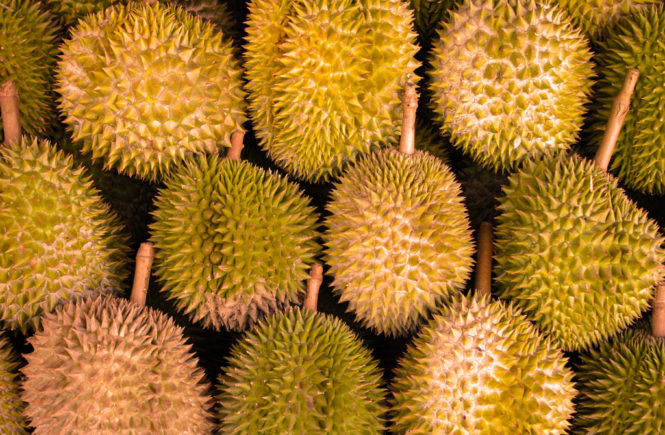
Kadayawan means concerts, agri fairs, mall sale, parades, fruits, and DURIAN.
It is my birthday celebration week already, but where is my durian?
Oh, there is durian alright. It is just way too expensive. Last year, you can buy a kilo of durian for P25-35 a kilo. Good luck finding that now. Today, the price of durian pegged at P150 a kilo. Yes folks you read that right — P150 a kilo.
A report from SunStar Davao said that “Prices for durian and other fruits for Kadayawan Festival is expected to be much expensive this year as compared to last year due to limited supply brought about by excess rain.”
The abnormally excessive amount of rainfall caused the flowers of the fruits, my beloved durian included, to fall off. No flower means no fruit.
Last year, we didn’t have much rain because of El Niño so we had plenty of durian at a very cheap price. However, we also had power outages because of the low water level in hydropower sources. But, we had lots of durian, and to me that balanced things out.
On my birthday, I wanted to eat lots of durian, except that I can’t have a mountain of it because of the price. I can’t even order a small hill of durian.
What’s my point, you ask. My point is this, I should be writing something about Kadayawan but all that is occupying my mind is durian. I can’t think straight. I need that creamy, sweet-smelling fruit to function and I need plenty of it.
It is a bummer when nature takes a different turn. It does not care if an entire city is celebrating its supposed bountiful harvest in its honor. It does not even care if it is my birthday.
However, life is still beautiful and there are so many things that are worth celebrating like the P150 per kilo durian or that I am alive and everybody I love are healthy and well.
We may not have plenty today, but tomorrow is another day that we can look forward to. And that is why we will celebrate.
Happy Kadayawan everybody. I’ve invited a lot of guests this year, so be sure to watch the parades on Saturday and Sunday. My friends from the food business have also come out this year and they are serving good food at the the food fair.
In this post, we feature Diana Lhyd Suelto’s review of a street food themed resto in Davao City.
Diana talks about a Malaysian street food restaurant in Davao which takes after the famous stretch o hawkers,food stalls and seafood reaturants in Jalan Alor : Malaysia. Here it goes:
The dining scene in Davao City used to have limited choices – tuna sutokil (sugba, tinola, kinilaw), pork and chicken barbecue, and the other usual Filipino fares. Today, however, we have a myriad of cuisines to choose from — Japanese, Chinese, Vietnamese, Middle Eastern, Korean, Indian, and American. Joining in the foray, wanting to carve a niche is Jalan Lok Lok and BBQ, a street food themed restaurant offering Malaysian dishes.
Jalan, which is located at Sobrecarey St, Obrero, serves traditional Malaysian fares such as beef rendang and nasi lemak. While these are delicious, it is their lok lok skewers that I like the most.
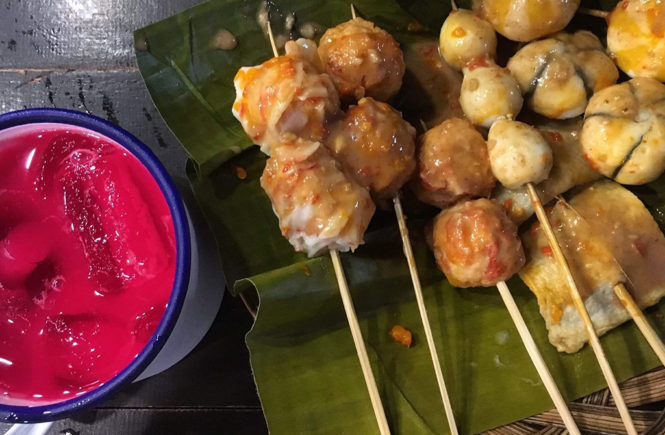
Lok lok skewers are basically flavored gluten balls that you dunk into a boiling chicken stock for two minutes to cook. Then you slather it with your choice of sauce. My favorites are the spicy sambal and peanut sauce.
I tried the Maranao version of beef rendang and it is a bit different from the one served in Jalan which is saucy. I like the Maranao version better but the one served in Jalan can hold its fort.
I am not a chicken fan, but I guess if you slather sambal all over your food it will taste good, because the nasi lemak (fried chicken with cucumber and egg on the side) tasted great.
There’s just one thing that did not suit my taste and that was their rose lassie, a rose flavored juice. It tastes of cheap perfume. But other than that, everything was superb.
Another thing worth noting is that the servers at Jalan are a very cheerful bunch. They were also very helpful to their ignorant customers (that’s me). They’ll make your dining experience more pleasant.
Martial Law be damned. There’s no better way to spend the weekend than to go on a froad (food road) trip to Buda in Marilog District to cool off and escape the city noise.
Unlike a few years back when you can’t find a decent place to eat, Buda (Bukidnon-Davao boundary) on the highlands of Davao City, is slowly transforming into a foodie destination. There are now quite a number of quaint restos that serve good food. Plus, the view each resto offers is nothing short of amazing.
Here are three of our favorite eat digs in Marilog:
La Toscana
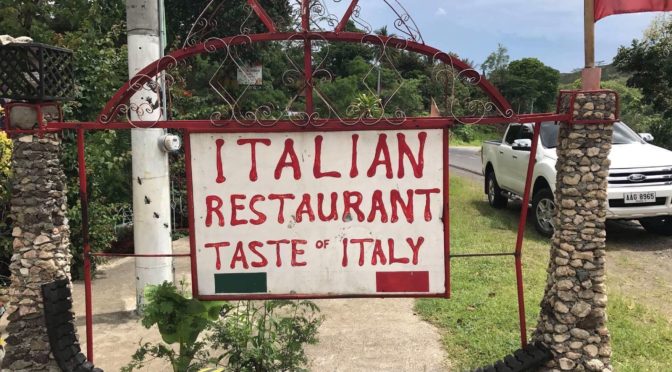
They serve some of the best pasta and pizza in Davao City. Their fresh noodle seafood pasta alone is worth the more than an hour drive. They also have a branch in Tionko Avenue in Downtown Davao, but their pizza tastes much better at their Buda branch. Both branches use the same recipe, but the long travel to get there makes the food taste much better.
Seagull Mountain Resort Steakhouse
This roadside restaurant has become the unofficial pitstop of motorists traveling to and from Bukidnon to Davao City. What made them famous is their delicious suman and sikwati combo. Your travel to Buda will not be complete if you don’t try this.
Wild Berry Resto
This rustic restaurant just before the quarantine stop in Lorega, Buda serves the most mouthwatering pork tenderloin steak in that part of the map. They also make a mean four berries shake with wild berry, that grows in their nearby farm, as their main ingredient.
Public advisories keep telling people to keep off crowded places, so what better place to go to than Buda. Tara na, adto ‘ta sa Buda.
The Island Garden City of Samal (IGaCoS) used to be known as the Moncadista Island, because it was once a colony of the Moncadistas, a religious group noted for eating only raw and uncooked food. In the late 1930’s they built two camps in Barangay Limao — Camp 23, a 23-hectare residential area for its members and Camp 19, a 19-hectare cultural heritage property where the White House is located.
The White House is where the group’s founder, Hilario Camino Moncado, used to occasionally stay. However, it was abandoned after its leader passed away at an early age. The property is still owned by the group and it is said that there are plans to renovate it and transform it into a tourism heritage center.
The house, which stands on top of a hill, gives visitors an amazing view of the Davao Gulf and the adjacent Davao City. It is not too far from the wharf in Babak, but the roads going up are a little rough. It is worth a visit though.
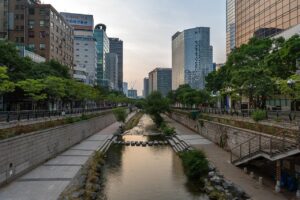
I was in Seoul on April 30, 2015, and I witnessed firsthand, a transformative power of urban renewal. What I saw was a remarkable example of ecological restoration: an area that had once been a bleak, concrete-covered artery—effectively a buried creek used as a thoroughfare—had been painstakingly reverted to its original, vibrant state.
Cheonggyecheon stream at sunrise with trees (Source:Basile Morin, CC BY-SA 4.0 <https://creativecommons.org/licenses/by-sa/4.0>, via Wikimedia Commons
The restoration of the Cheong Gye Cheon (Cheonggyecheon) stream is a world renowned case study in urban greening and environmental engineering. The original creek, which had been paved over and obscured by an elevated highway for decades, was brought back to life as a flowing waterway. The difference between its past function as a piece of infrastructure and its current form as an ecological public space is staggering.
Today, the Cheong Gye Cheon is a beautiful, accessible urban park featuring a clean, overflowing stream that runs through the heart of the city. This project has not only enhanced the aesthetic appeal of Seoul but has also yielded significant environmental benefits, such as reducing the urban heat island effect, creating a natural habitat for various flora and fauna, and serving as a vital community space for recreation and relaxation. Seeing the water flowing and people enjoying the restored natural environment was a powerful testament to the vision and commitment behind the project.
The remarkable restoration of the Cheong Gye Cheon stream stands as a powerful symbol of Seoul’s unwavering commitment to urban “greening” and sustainability. It is a profound testament to the notion that urban decay is not an immutable fate, but a challenge that can be overcome with an unbridled passion, ambitious vision, and decisive action. The core of this transformation is astounding: a massive, elevated highway—a symbol of mid-20th-century urban prioritization of automobiles—was deliberately dismantled to breathe life back into a historic stream that had been tragically buried and forgotten for over 600 years.
A Stream’s History: From Lifeline to Lost Memory
The history of Cheong Gye Cheon reflects the tumultuous journey of Seoul itself. During the Joseon Dynasty, which spanned from 1392 to 1910, the stream was a vibrant artery flowing through the heart of central Seoul, running from west to east. It was a vital piece of the city’s social fabric, serving as a communal space where housewives congregated for the daily chore of laundry, and children found a natural playground.
However, the 20th century brought rapid, often unplanned, urbanization. Following the devastation of the Korean War (1950-1953), Seoul experienced a massive influx of rural migrants seeking employment and a better life. Lacking formal housing, these newcomers constructed a dense patchwork of makeshift homes—a sprawling shantytown—along the banks of the stream. This concentrated, unregulated development quickly led to severe pollution, sanitation crises, and a highly degraded aesthetic condition.
In response to these mounting problems, municipal efforts began in 1958 to “improve” the area, a process that primarily involved covering the festering stream with concrete. This immense civil engineering task continued for nearly two decades. By 1976, the final, most defining act of erasure was complete: an elevated highway was constructed directly over the newly covered waterway. Consequently, Cheong Gye Cheon, the historic lifeline, completely vanished from the city’s consciousness, replaced by a concrete monument to modernization.
The Vision and the Battle for Restoration
The monumental decision to reverse this historical trajectory was championed by Lee Myung-bak, who was then the mayor of Seoul and would later go on to become the President of South Korea. He boldly greenlighted the ambitious restoration project, recognizing the immense cultural, environmental, and public health value it would bring.
The decision, however, was met with significant initial resistance. The project posed a direct threat to the established order, drawing objections from storeowners and street vendors whose small businesses operated along the highway, as well as from urban developers and, crucially, the tens of thousands of commuters reliant on the major traffic artery. The primary hurdles were complex: relocating countless businesses, managing the displacement of a major transportation route, and convincing a skeptical public of the long-term benefits.
The administration successfully navigated this opposition by reframing the project not as a disruption, but as an essential element of Seoul’s future. Opponents gradually came to understand that the restoration of Cheonggyecheon was a crucial component of a broader, global movement to re-introduce nature into dense urban environments, promoting a more eco-friendly, sustainable, and human-centered urban design. The project became a symbol of prioritizing quality of life over raw traffic efficiency.
A Triumph of Urban Ecology and Public Space
The intense work commenced on July 21, 2003, and was completed with remarkable speed, culminating in its grand reopening on October 1, 2005. The restored stream has since become an overwhelmingly popular destination, transforming a once-blighted area into a thriving urban oasis.
The popularity metrics speak volumes. According to a tourist information officer, the stream now attracts an astonishing average of over 500,000 people who walk alongside its banks each week. The restored waterway has deeply integrated itself into the daily rhythms of Seoulites. In the crisp mornings, groups of brightly clad ajummas (a respectful term for married women) engage in power-walking along the pedestrian paths, embodying the city’s health-conscious culture. At night, when the banks are softly illuminated, the stream transforms into a romantic setting, with couples strolling slowly, arm-in-arm.
Beyond its aesthetic and recreational appeal, the restoration has yielded significant ecological benefits. The project has actively re-established a habitat within the city center, leading to a demonstrable increase in biodiversity, marked by a growing number of fish and various bird species returning to the cleaner waters of the stream. Cheong Gye Cheon is now a living, breathing component of Seoul, a powerful monument to the vision that a city can both thrive and coexist with nature.
The success story of Cheong Gye Cheon offers more than just a remarkable case study; it provides an actionable blueprint for what is possible in densely populated urban centers worldwide. It is my deepest hope that this magnificent feat of green urban renewal can serve as a powerful catalyst for similar, ambitious undertakings across the Philippines. Facing critical challenges of pollution and congestion in major metropolitan areas like Metro Manila, our local leaders and communities should look to Seoul’s bold decision to prioritize people and nature over concrete infrastructure. The restoration of our own buried or polluted waterways and the reclamation of vital public spaces, driven by political will and a sustained vision, could similarly transform our blighted areas into resilient, sustainable, and human-centered environments, proving that a greener, more livable future for the Filipino people is unequivocally within reach.






 The Island Garden City of Samal (IGaCoS) used to be known as the Moncadista Island, because it was once a colony of the Moncadistas, a religious group noted for eating only raw and uncooked food. In the late 1930’s they built two camps in Barangay Limao — Camp 23, a 23-hectare residential area for its members and Camp 19, a 19-hectare cultural heritage property where the White House is located.