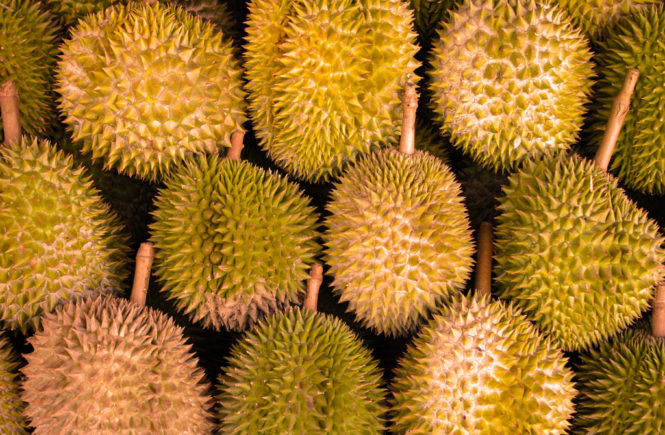
Where is my Kadayawan Durian?

Fruits will not come cheap during this weekend’s Kadayawan celebration. Visitors will have to fork out more bucks per kilo in order to enjoy what little harvests maybe available. But yet, there are other things worth celebrating as Dianne Suelto writes below:

I always tell people who are willing to listen that the Kadayawan Festival is a weeklong celebration of my birthday. Davao City was just so happy to learn of my birth that they decided to throw me a grand party complete with parades and floats to thank the heavens of their good fortune of having me. 

Of course the story’s baloney, Kadayawan is really a thanksgiving festival for the bountiful harvest given by nature. But it is my story, I decide the plot. 

Kadayawan means concerts, agri fairs, mall sale, parades, fruits, and DURIAN. 
It is my birthday celebration week already, but where is my durian? 

Oh, there is durian alright. It is just way too expensive. Last year, you can buy a kilo of durian for P25-35 a kilo. Good luck finding that now. Today, the price of durian pegged at P150 a kilo. Yes folks you read that right — P150 a kilo. 

A report from SunStar Davao said that “Prices for durian and other fruits for Kadayawan Festival is expected to be much expensive this year as compared to last year due to limited supply brought about by excess rain.”

The abnormally excessive amount of rainfall caused the flowers of the fruits, my beloved durian included, to fall off. No flower means no fruit. 

Last year, we didn’t have much rain because of El Niño so we had plenty of durian at a very cheap price. However, we also had power outages because of the low water level in hydropower sources. But, we had lots of durian, and to me that balanced things out. 

On my birthday, I wanted to eat lots of durian, except that I can’t have a mountain of it because of the price. I can’t even order a small hill of durian.

What’s my point, you ask. My point is this, I should be writing something about Kadayawan but all that is occupying my mind is durian. I can’t think straight. I need that creamy, sweet-smelling fruit to function and I need plenty of it. 

It is a bummer when nature takes a different turn. It does not care if an entire city is celebrating its supposed bountiful harvest in its honor. It does not even care if it is my birthday. 

However, life is still beautiful and there are so many things that are worth celebrating like the P150 per kilo durian or that I am alive and everybody I love are healthy and well. 

We may not have plenty today, but tomorrow is another day that we can look forward to. And that is why we will celebrate.

Happy Kadayawan everybody. I’ve invited a lot of guests this year, so be sure to watch the parades on Saturday and Sunday. My friends from the food business have also come out this year and they are serving good food at the the food fair. 

Enjoy my party!
Of Horses and Horsefighting

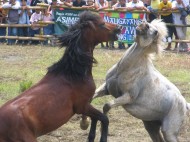
Two stallions in a horsefight during a city-wide thanksgiving festival
A 1950s photograph of a relative proudly atop his most prized possession at that time -his horse.
Horse Ownership: A status symbol
Ownership of a horse  especially among the lumads and upland farmers in my part of Mindanao is some form of a status symbol. Wealth and stature is judged by the number and quality of horses a man owns.  Horses are not only primary means of transport used to carry  people and crops to the lowlands, but as medium of exchange in lieu of money. Horses are given to a bride  as  a dowry; offered to an aggrieved family to settle blood debts;  and, as gifts to cement various forms of peace settlements among warring families.

And of course, the worthier horses are those which won more fights in horsefighting events.

 Fiestas and Festivals Features Horsefighting 

Horse fighting are featured events in  annual fiestas, thanksgiving festivals and during celebrations by locals to honor a special guest. I have been to some of these events, and they are very much like cockfights in terms of the betting that goes around;  and like the present day Universal Fighting Contests in the degree of brutality between combatants.

Two stallions in a horsefight during a city-wide thanksgiving festival

Briefly, this is how it goes. The organizers build  an enclosed pen.  A mare that is in heat is tethered in the  pen.  It ignites the sexual desire of two stallions and will lead to a fight to determine which between the two of them will become the female’s partner. During such fights the horses push, shove, head-but, bite, and kick each other to submission.  A stallion loses the fight if it runs out of the pre-defined ring drawn within the enclosed pen or,  if his owner will throw the towel to prevent further harm to his horse.  In some cases, the organizers allow the victorious stallion to mate the mare.

Hundreds, if not thousands of people watch the horse fights.  Children climb trees for a better view of the festival. There is a lot of shouting and jeering from the crowd.  Bet taking precedes the fight very much like what happens in a cockpit arena.

Before horsefighting was outlawed by the Animal Welfare Act of 2009, various festivals in Mindanao have horse fighting as one of their featured events: the  Lemlunay Festival of the T’bolis in South Cotabato;  the Dorong Festival in Digos Davao del Sur;  during several fiestas in North Cotabato; and,  during the Kadayawan Festival in Davao City to name a few I am familiar with.  Now, some local governments have stopped the events during fiestas, but some enthusiasts are still holding such events insisting  that it is part of their culture and even complaining that  it should be allowed since cockfighting is legal in this country.

I have not watched horsefighting  in the past several years. The last one was in 2004 during the Kadayawan festival and I am sharing with you a short video that I took of that event.

Horsefighting during Kadayawan 2004