The Island Garden City of Samal (IGaCoS) used to be known as the Moncadista Island, because it was once a colony of the Moncadistas, a religious group noted for eating only raw and uncooked food. In the late 1930’s they built two camps in Barangay Limao — Camp 23, a 23-hectare residential area for its members and Camp 19, a 19-hectare cultural heritage property where the White House is located.
The White House is where the group’s founder, Hilario Camino Moncado, used to occasionally stay. However, it was abandoned after its leader passed away at an early age. The property is still owned by the group and it is said that there are plans to renovate it and transform it into a tourism heritage center.
The house, which stands on top of a hill, gives visitors an amazing view of the Davao Gulf and the adjacent Davao City. It is not too far from the wharf in Babak, but the roads going up are a little rough. It is worth a visit though.
Here is one story I got from a friend via mail. It is an interesting lesson on life, relationship and friendship. I hope you will enjoy this.
PASS THE BISCUITS
When I was a kid, my mum liked to make breakfast food for dinner
every now & then & I remember one night in particular when she had
made breakfast after a long, hard day at work. On that evening
so long ago, my mum placed a plate of eggs, sausage, and extremely burned biscuits in front of my dad. I remember waiting to see if anyone noticed!
Yet all my dad did was reach for his biscuit, smile at my mum and ask me how my day was at school.
I don’t remember what I told him that night, but I do remember hearing my mum apologize to my dad for burning the biscuits. And I’ll never forget what he said: “Honey, I love burned biscuits.”
Later that night, I went to kiss Daddy good night and I asked him if he really liked his biscuits burned.
He wrapped me in his arms and said, “Your mummy put in a long hard day at work today and she’s real tired. And besides… A burnt biscuit never hurt anyone!”
You know, life is full of imperfect things… And imperfect people. I’m not the best at hardly anything and I forget birthdays and anniversaries just like everyone else.
What I’ve learned over the years is that learning to accept each others faults and choosing to celebrate each other’s differences, is one of the most important keys to creating a healthy, growing, and lasting relationship.
So…please pass me a biscuit. And yes, the burned one will do just fine!
And please pass this along to someone who has enriched your life…I just did!
Life is too short to wake up with regrets… Love the people who treat you rightand forget about the ones who don’t.
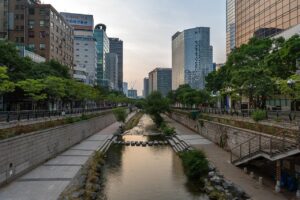
I was in Seoul on April 30, 2015, and I witnessed firsthand, a transformative power of urban renewal. What I saw was a remarkable example of ecological restoration: an area that had once been a bleak, concrete-covered artery—effectively a buried creek used as a thoroughfare—had been painstakingly reverted to its original, vibrant state.
Cheonggyecheon stream at sunrise with trees (Source:Basile Morin, CC BY-SA 4.0 <https://creativecommons.org/licenses/by-sa/4.0>, via Wikimedia Commons
The restoration of the Cheong Gye Cheon (Cheonggyecheon) stream is a world renowned case study in urban greening and environmental engineering. The original creek, which had been paved over and obscured by an elevated highway for decades, was brought back to life as a flowing waterway. The difference between its past function as a piece of infrastructure and its current form as an ecological public space is staggering.
Today, the Cheong Gye Cheon is a beautiful, accessible urban park featuring a clean, overflowing stream that runs through the heart of the city. This project has not only enhanced the aesthetic appeal of Seoul but has also yielded significant environmental benefits, such as reducing the urban heat island effect, creating a natural habitat for various flora and fauna, and serving as a vital community space for recreation and relaxation. Seeing the water flowing and people enjoying the restored natural environment was a powerful testament to the vision and commitment behind the project.
The remarkable restoration of the Cheong Gye Cheon stream stands as a powerful symbol of Seoul’s unwavering commitment to urban “greening” and sustainability. It is a profound testament to the notion that urban decay is not an immutable fate, but a challenge that can be overcome with an unbridled passion, ambitious vision, and decisive action. The core of this transformation is astounding: a massive, elevated highway—a symbol of mid-20th-century urban prioritization of automobiles—was deliberately dismantled to breathe life back into a historic stream that had been tragically buried and forgotten for over 600 years.
A Stream’s History: From Lifeline to Lost Memory
The history of Cheong Gye Cheon reflects the tumultuous journey of Seoul itself. During the Joseon Dynasty, which spanned from 1392 to 1910, the stream was a vibrant artery flowing through the heart of central Seoul, running from west to east. It was a vital piece of the city’s social fabric, serving as a communal space where housewives congregated for the daily chore of laundry, and children found a natural playground.
However, the 20th century brought rapid, often unplanned, urbanization. Following the devastation of the Korean War (1950-1953), Seoul experienced a massive influx of rural migrants seeking employment and a better life. Lacking formal housing, these newcomers constructed a dense patchwork of makeshift homes—a sprawling shantytown—along the banks of the stream. This concentrated, unregulated development quickly led to severe pollution, sanitation crises, and a highly degraded aesthetic condition.
In response to these mounting problems, municipal efforts began in 1958 to “improve” the area, a process that primarily involved covering the festering stream with concrete. This immense civil engineering task continued for nearly two decades. By 1976, the final, most defining act of erasure was complete: an elevated highway was constructed directly over the newly covered waterway. Consequently, Cheong Gye Cheon, the historic lifeline, completely vanished from the city’s consciousness, replaced by a concrete monument to modernization.
The Vision and the Battle for Restoration
The monumental decision to reverse this historical trajectory was championed by Lee Myung-bak, who was then the mayor of Seoul and would later go on to become the President of South Korea. He boldly greenlighted the ambitious restoration project, recognizing the immense cultural, environmental, and public health value it would bring.
The decision, however, was met with significant initial resistance. The project posed a direct threat to the established order, drawing objections from storeowners and street vendors whose small businesses operated along the highway, as well as from urban developers and, crucially, the tens of thousands of commuters reliant on the major traffic artery. The primary hurdles were complex: relocating countless businesses, managing the displacement of a major transportation route, and convincing a skeptical public of the long-term benefits.
The administration successfully navigated this opposition by reframing the project not as a disruption, but as an essential element of Seoul’s future. Opponents gradually came to understand that the restoration of Cheonggyecheon was a crucial component of a broader, global movement to re-introduce nature into dense urban environments, promoting a more eco-friendly, sustainable, and human-centered urban design. The project became a symbol of prioritizing quality of life over raw traffic efficiency.
A Triumph of Urban Ecology and Public Space
The intense work commenced on July 21, 2003, and was completed with remarkable speed, culminating in its grand reopening on October 1, 2005. The restored stream has since become an overwhelmingly popular destination, transforming a once-blighted area into a thriving urban oasis.
The popularity metrics speak volumes. According to a tourist information officer, the stream now attracts an astonishing average of over 500,000 people who walk alongside its banks each week. The restored waterway has deeply integrated itself into the daily rhythms of Seoulites. In the crisp mornings, groups of brightly clad ajummas (a respectful term for married women) engage in power-walking along the pedestrian paths, embodying the city’s health-conscious culture. At night, when the banks are softly illuminated, the stream transforms into a romantic setting, with couples strolling slowly, arm-in-arm.
Beyond its aesthetic and recreational appeal, the restoration has yielded significant ecological benefits. The project has actively re-established a habitat within the city center, leading to a demonstrable increase in biodiversity, marked by a growing number of fish and various bird species returning to the cleaner waters of the stream. Cheong Gye Cheon is now a living, breathing component of Seoul, a powerful monument to the vision that a city can both thrive and coexist with nature.
The success story of Cheong Gye Cheon offers more than just a remarkable case study; it provides an actionable blueprint for what is possible in densely populated urban centers worldwide. It is my deepest hope that this magnificent feat of green urban renewal can serve as a powerful catalyst for similar, ambitious undertakings across the Philippines. Facing critical challenges of pollution and congestion in major metropolitan areas like Metro Manila, our local leaders and communities should look to Seoul’s bold decision to prioritize people and nature over concrete infrastructure. The restoration of our own buried or polluted waterways and the reclamation of vital public spaces, driven by political will and a sustained vision, could similarly transform our blighted areas into resilient, sustainable, and human-centered environments, proving that a greener, more livable future for the Filipino people is unequivocally within reach.
Honesty is among the traits the Batans pride themselves with. But can you expect the same things from people not from Batanes?
Honesty Cafe proves we can.
This is a small store (probably 20 to 30 sqm ) located near the Port of Ivana. Locals said it is open 24/7. Yet, no one is manning the store. No cashiers. No attendants. Only a sign ” The Lord is my security guard” comes close to a deterrent to anybody who may have evil designs.
If you need to buy something, all you have to do is get that item, — coffee, bread, native crafts. Prices are written on the items. You leave your payment in a box marked for that purpose. Of course, no change can be given so one has to either pay the exact amount or leave a bit more money than the cost of the goods taken.
I first heard these words from a sweepstakes ticket vendor who exhorted patrons to continue buying from him.
Persistence, that is what it is called. But this thing took on a new meaning to me when I chance upon a section of the book Chicken Soup for the Soul by Jack Canfield and Mark Victor Hansen on Overcoming Obstacles. It talked about how one of the greatest leaders in history may have exemplified this trait. It talked about how Abraham Lincoln did not quit, and eventually won!
Today, on his 150th death anniversary, let me share how Lincoln breathed life into the word — persistence:
Born into poverty, Lincoln was faced with defeat throughout his life. He lost eight elections, twice failed in business and suffered a nervous breakdown.
He could have quit many times but he didn’t and because he didn’t quit, he became one of the greatest presidents in the history of America.
Lincoln was a champion and he never gave up. Here is a sketch of Lincoln’s road to the White House.
1816: His family was forced out of their home. He had to work to support them.
1818: His mother died.
1831: Failed in business.
1832: Ran for state legislature- lost.
1832: Also lost his job. Wanted to go to law school but couldn’t get in.
1833: Borrowed some money from a friend to begin a business and by the end of the year he was bankrupt. He spent the next 17 years of his life paying off this debt.
1834: Ran for state legislature again – won.
1835: Was engaged to be married , sweetheart died and his heart was broken.
1836:Had a total nervous breakdown and was in bed for six months.
1838:Sought to become speaker of the state legislature – defeated.
1840: Sought to became elector- defeated.
1843: Ran for Congress-lost.
1846:Ran for Congress again. This time he won-went to Washington and did a good job.
1848:Ran for re-election to Congress – lost.
1849:Sought the job of land officer in his home state-rejected.
1854:Ran for Senate of the United States-lost.
1856:Sought the Vice-Presidential nomination at his party’s national convention-got less than 100 votes.

 The Island Garden City of Samal (IGaCoS) used to be known as the Moncadista Island, because it was once a colony of the Moncadistas, a religious group noted for eating only raw and uncooked food. In the late 1930’s they built two camps in Barangay Limao — Camp 23, a 23-hectare residential area for its members and Camp 19, a 19-hectare cultural heritage property where the White House is located.